
Knox County Criminal Court Cases
The combined Knox County and District Clerk keeps the filed cases for the county. The office is on the first floor of the courthouse at 100 W. Cedar Street in Benjamin, uses PO Box 196, and answers at (940) 459-2441. It is the practical first stop for a filed felony or county-level criminal matter. Ask the clerk to confirm whether a search can be run by name, date, or case number and whether copies can be delivered remotely.
A court file answers a different question from an arrest report. It reflects the charge the prosecutor actually filed, the court’s orders, pleas, motions, judgment, sentence, dismissal, or other disposition. An arrest allegation can be changed, reduced, enhanced, or declined before it becomes a Knox County court case.
The official clerk page shows the local records office and contact route.
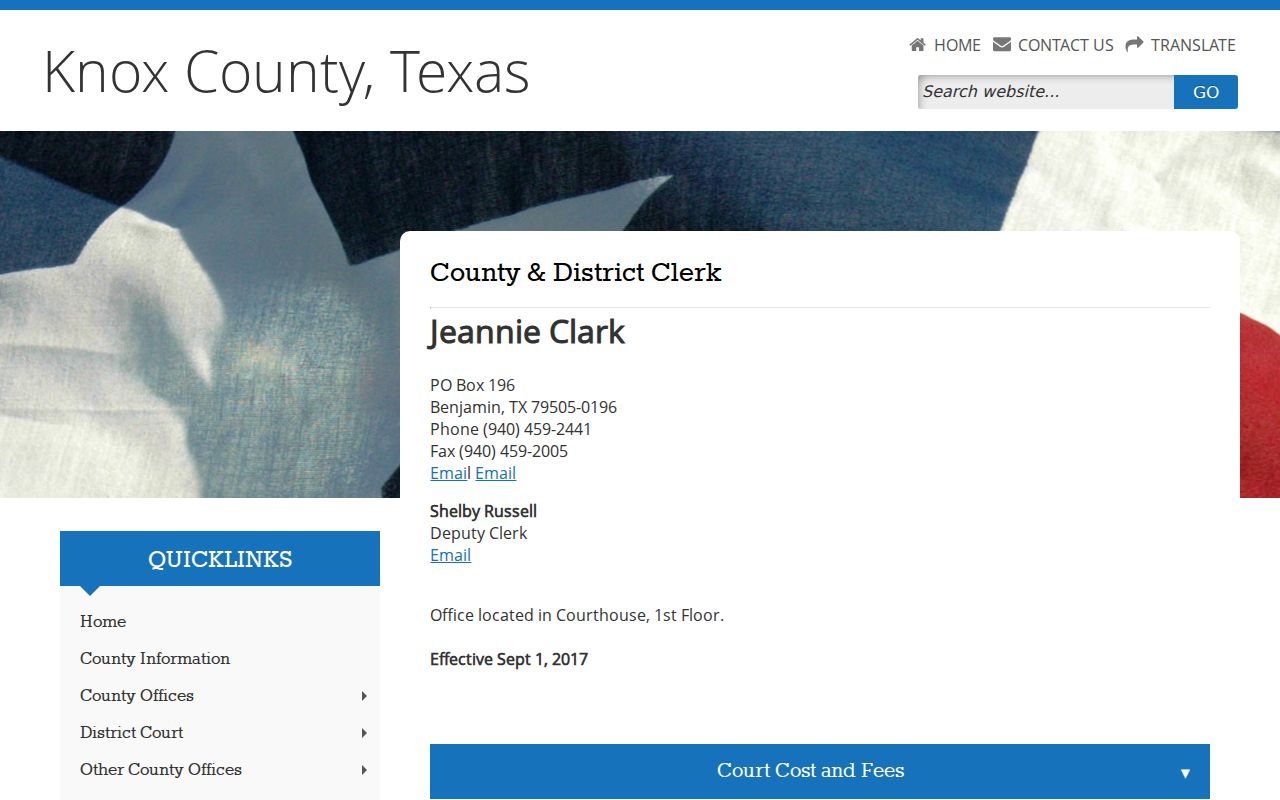
That clerk—not the sheriff or jail—can authenticate the filed docket and final disposition.
Four Knox County Court Levels
Choosing the correct custodian prevents a request from circling among offices. The 50th District Court hears Knox felony matters and also serves Baylor, Cottle, and King Counties. The County Court handles county-level jurisdiction where applicable. The Justice of the Peace handles fine-only and traffic matters as well as magistration, while Knox City and Munday retain their own municipal files.
County & District Clerk
100 W. Cedar St., first floor
Benjamin, TX 79505
(940) 459-2441
50th District Court
PO Box 1127
Seymour, TX 76380
(940) 889-6912
County Court
Courthouse first floor
PO Box 77
(940) 459-2191
Justice of the Peace
Courthouse second floor
PO Box 76
(940) 459-3181
The official Justice of the Peace page confirms the fine-only court contact.
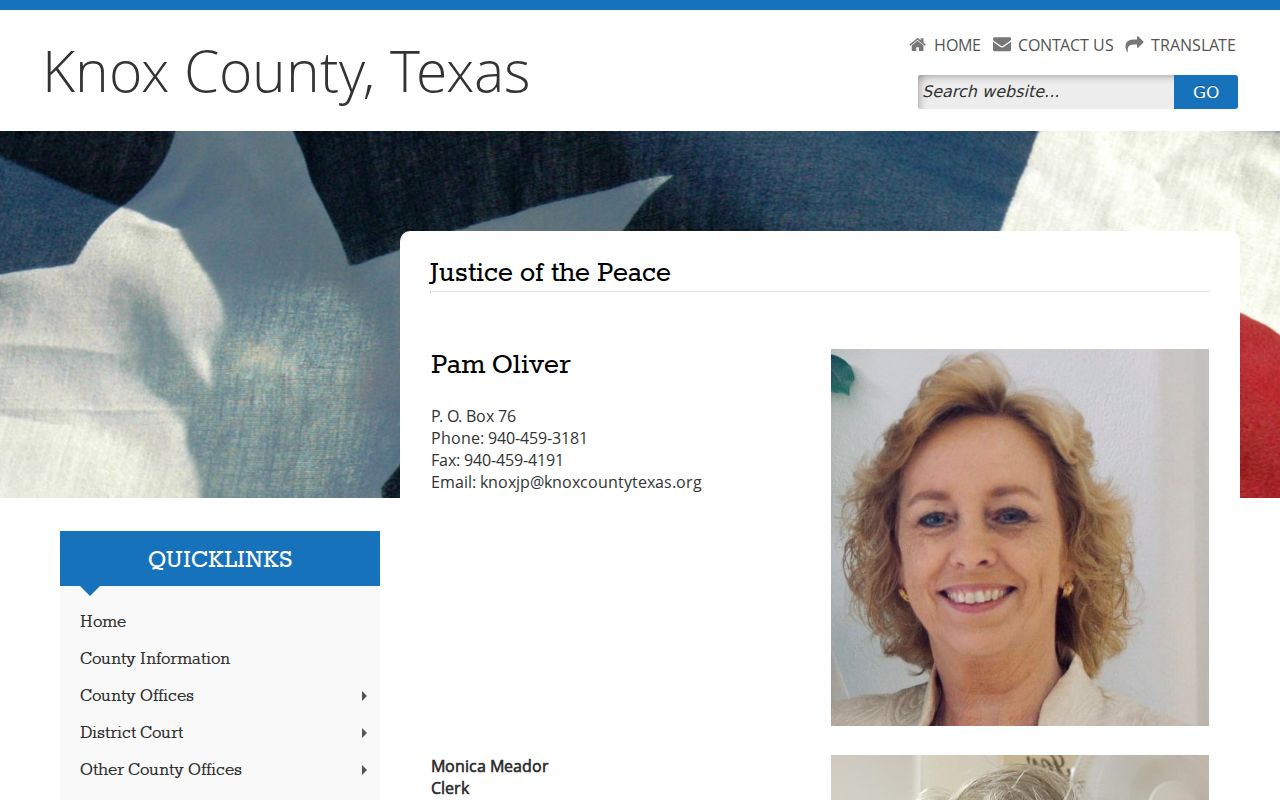
This lower-court channel should be checked when a citation or paperwork names the JP rather than the district or county court.
Municipal and justice-court jurisdiction should not be inferred from the offense description alone. The document’s court name, citation number, and response instructions are the practical routing clues. A fine-only matter can remain outside the combined clerk’s ordinary felony and county files, while a later failure-to-appear process may require confirmation from the court that issued it.
Searching Knox County Case Records
Knox County advertises no public local case portal and the research located no sample Knox docket online. A complete search uses direct clerk contact first and treats the statewide platform as a possible supplement. Have the person’s full name, approximate filing date, date of birth if lawfully available, charge, and case number ready.
- Read the citation, bond paper, charging instrument, or notice to identify the court.
- Call the County and District Clerk for felony or county case filings; call the JP or named municipal court for fine-only matters.
- Ask for a name or case-number search and request the docket sheet, charging paper, bond order, plea papers, judgment, sentence, and disposition.
- Try re:SearchTX for supplementary statewide electronic access, without assuming Knox participation or document coverage.
- Ask the originating clerk about ordinary or certified copies, delivery, current fees, and older paper archives before paying.
Knox copy prices and archive coverage were not published. The county’s $350 listing is an expunction filing fee, not a court-copy fee.
When requesting an older file, ask whether the clerk needs an approximate year or archived case number and whether staff will quote retrieval and certification charges before producing it. A request for a “criminal history” can be too broad for a court counter; naming the court record sought and the likely filing window gives the custodian a concrete search.
re:SearchTX for Knox County Cases
re:SearchTX is Texas’s statewide electronic court-record platform, but access depends on clerk participation, permissions, and which documents entered the electronic system. Knox County does not advertise it as a local public portal. A missing result therefore does not prove that no case exists.
| Search input | Use | Limitation |
|---|---|---|
| Party name | Find possible matters associated with a spelling | Common names and variants can produce ambiguity |
| Case number | Targets a known docket | Requires the court’s exact number format |
| Court or county | Narrows statewide results | Coverage still depends on participating records |
| Date range | Separates similarly named matters | Older or paper files may not appear |
The re:SearchTX landing page illustrates the statewide route available to a Knox County searcher.
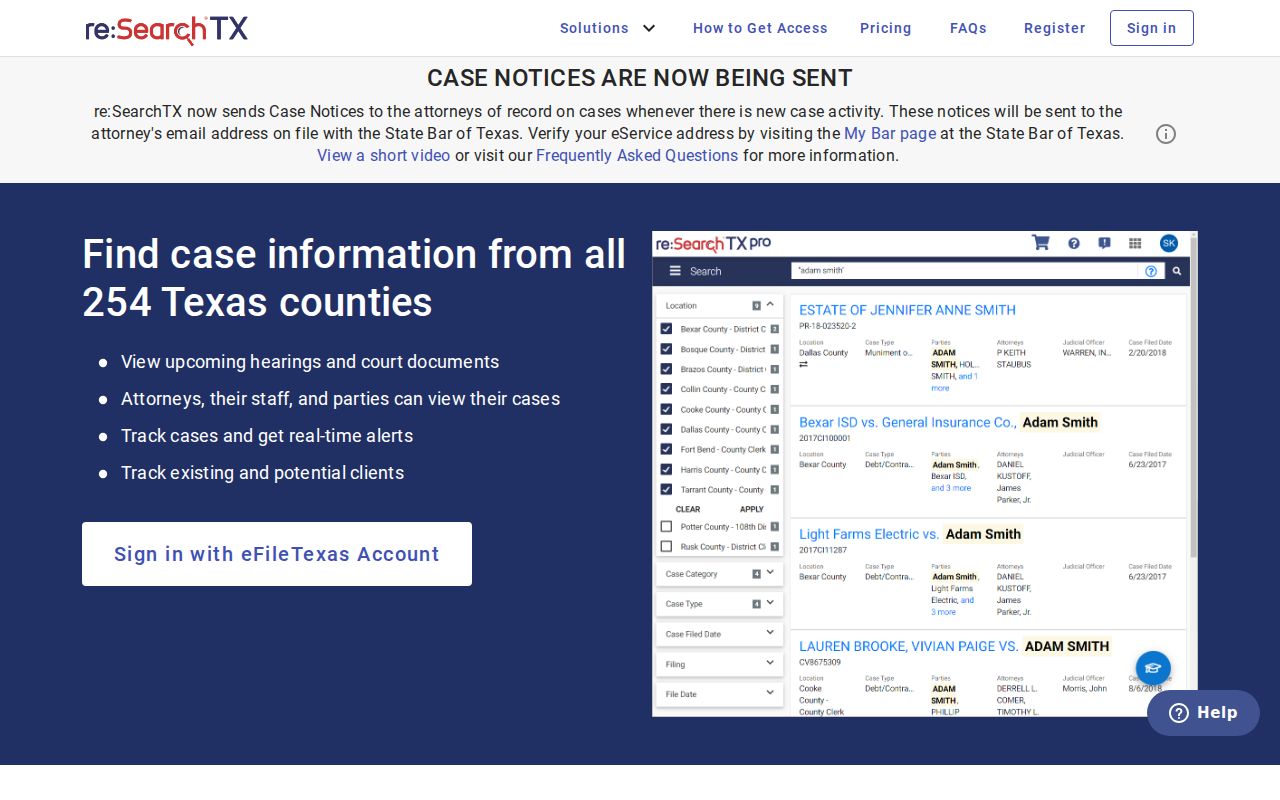
Any electronic hit should be confirmed against the Knox clerk’s official case file before relying on a disposition.
Inside a Knox County Case File
A court record is organized around the filed prosecution, not merely the event described at arrest. The docket is the chronological index; individual filings and orders supply the detail. Availability varies by case and confidential information may be redacted.
| Case identifiers | Case number, court, caption, parties, and filing date. |
|---|---|
| Charging document | Complaint, information, or indictment stating the filed allegation and statute. |
| Docket activity | Hearings, appearances, motions, continuances, and orders entered over time. |
| Release material | Bond order, conditions, and related appearance requirements when filed. |
| Outcome | Plea, dismissal, acquittal, conviction, judgment, sentence, and costs as applicable. |
| Certification | Clerk authentication when an official copy is requested and available. |
Grand-jury deliberations are not the public indictment. Protected identifiers, juvenile information, victim details, and sealed material are not converted into public information simply because other docket entries are open.
For a reliable reading, compare the charging instrument with the final judgment rather than treating the first charge as the outcome. The docket can reveal that an order exists, but the order itself supplies its terms. Certified copies matter when the requester needs the clerk to attest that the document came from the official Knox County file.
Knox County 50th District Cases
Felony cases from Knox County proceed in the 50th Judicial District Court. Judge Jennifer Habert’s administrative contact is at PO Box 1127 in Seymour, with telephone (940) 889-6912, but the combined clerk in Benjamin keeps the Knox filings. That division of labor matters: administrative scheduling questions may go to the district court, while a request for a Knox pleading, docket, judgment, or certified copy begins with the clerk.
The official district judge page identifies the four-county district and its contact point.
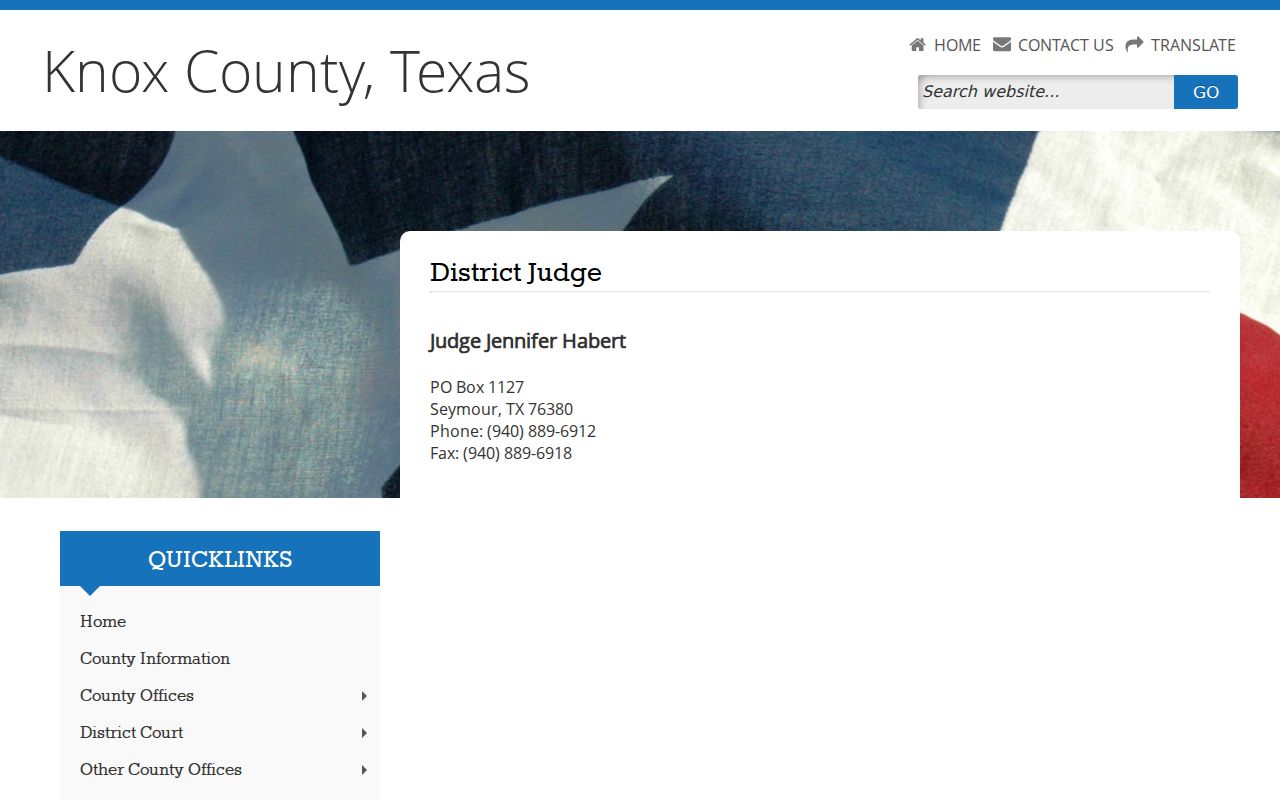
The image reinforces why court location and record custody should be confirmed separately before travel.
How a Criminal Case Moves
The court file grows only after a prosecutor files a charge. Each stage can add a separate entry, and the final result can differ substantially from the allegation listed in a booking record.
Case flow: Charges Filed › Arraignment › Pretrial › Plea or Trial › Disposition › Sentencing
- Arraignment
- The formal court appearance at which the charge is called and a plea is addressed.
- Disposition
- The outcome entry, such as dismissal, acquittal, deferred adjudication, or conviction.
- Information
- A prosecutor-filed charging instrument commonly used for an eligible non-felony case.
- Indictment
- A grand-jury felony accusation; it is an accusation rather than proof of guilt.
A later DPS criminal-history entry depends on the court and prosecutor outcome being reported back through Texas criminal-justice channels. The clerk’s file remains the source for the local judicial record.
Community supervision, restitution, concurrent sentences, and consecutive sentences can appear in sentencing material and should be read exactly as ordered. Parole, by contrast, concerns conditional release after prison and is administered through state authorities. Neither term should be substituted for the other when summarizing a Knox County disposition.
Knox County Municipal Case Files
Knox City Municipal Court is at 902 E. Main and holds court Thursdays from 5:30 to 8 p.m.; call (940) 658-3313 before a visit. Munday’s municipal contact routes through the city at 121 E. Main, (940) 422-4331, or cityjudge@mundaytexas.com. Neither city publishes an online case portal.
These courts deal with city ordinance, traffic, and fine-only matters rather than felonies or Class A and B misdemeanors. Ask by name, citation number, and date. Texas Code of Criminal Procedure article 45A.461 can make many fine-only records confidential five years after a final conviction or deferred-disposition dismissal, subject to statutory exceptions.
Note: Send a municipal citation request to the court printed on the paperwork, not automatically to the county clerk.
Case Record Access & Restrictions
Judicial case records are not handled under the Texas Public Information Act in exactly the same manner as a sheriff’s administrative records. The Texas Rules of Judicial Administration, Rule 12, supplies a judicial-record access framework, while case files are requested through the responsible clerk and applicable court rules.
Access boundaries: Juvenile files, sealed or expunged matters, protected victim and minor information, medical data, Social Security numbers, and other confidential identifiers may be unavailable or redacted. An order of nondisclosure restricts ordinary public dissemination but does not erase the record for every authorized purpose.
For a definitive outcome, request the final judgment or dismissal and ask whether it is certified. A docket summary alone may omit the text of an order, and a statewide name result may not resolve identity.
Reading Knox County Court Outcomes
“Dismissed,” “deferred adjudication,” and “convicted” have different consequences. A dismissal terminates the charge without a conviction, while deferred adjudication postpones a guilt finding during community supervision and is not interchangeable with an acquittal. A conviction is the court’s judgment of guilt. “No-bill” means a grand jury declined an indictment; “nolle prosequi” describes a prosecution that was declined or terminated.
When the docket uses an abbreviation, ask the clerk for the underlying order rather than guessing. Match the case number, court, filed charge, disposition date, and sentence across the docket and judgment. If a Knox disposition does not appear correctly in a personal DPS record, obtain certified court documents and use DPS error resolution.
Note: A court-file search is the best local path to what was charged and decided; it is not a substitute for fingerprint identity confirmation.