
Checking Criminal History in Knox City
Begin with the record closest to the event. Knox City does not publish one portal that joins police reports, municipal citations, jail bookings, county cases, and Texas criminal-history data. The local route is direct contact with Police or Municipal Court. County and state offices answer different questions later in the process. Having a full name, an approximate date, a location, and any report or citation number lets staff narrow the search without treating similar names as the same person.
- Contact Knox City Police for a police-created incident, offense, arrest, or citation record. Give the date, time, place, and report number when known.
- Ask for an existing record in a clear format. State whether electronic delivery, paper copies, or inspection would meet the need.
- Contact Knox City Municipal Court for a citation, fine-only city case, docket entry, or judicial outcome. The court does not advertise an online search.
- If custody occurred, ask Knox County Jail whether it accepted the person. For higher charges, contact the combined County and District Clerk.
- Use the Texas DPS public name search for reported conviction and deferred-adjudication information, or use fingerprint review for a reliable check of your own Texas record.
Each step confirms a different layer. A police record can show what an officer reported. The municipal or county court file shows what was filed and how the court acted. DPS depends on later agency submissions and should not replace the local source.
Knox City Records at East Main
Knox City Police and Municipal Court publish the same contact point: 902 E. Main Street, Knox City, TX 79529, (940) 658-3313, and citykc@srcaccess.net. Sharing one address does not merge their files. Ask which office holds the specific item before a visit. Police may have the event narrative or its citation copy. Court staff may have the cause, plea, payment, dismissal, or other judicial action.
The official Knox City home shows the city source behind this shared local access point.

This city-level source helps keep a Knox City request from being misdirected to a county or state office that did not create the record.
Knox City Local Records
Police and Municipal Court
902 E. Main Street
Knox City, TX 79529
(940) 658-3313
citykc@srcaccess.net
Knox City Police Department Records
The Knox City Police Department is the first stop for a record created by a city officer. No separate records unit, downloadable request form, report portal, public blotter, app, fee schedule, or records-counter hours were found. Call or email first. Describe the existing document instead of asking for a broad background report. Useful details include the incident number, exact or approximate date and time, location, agency, type of event, and preferred copy format.
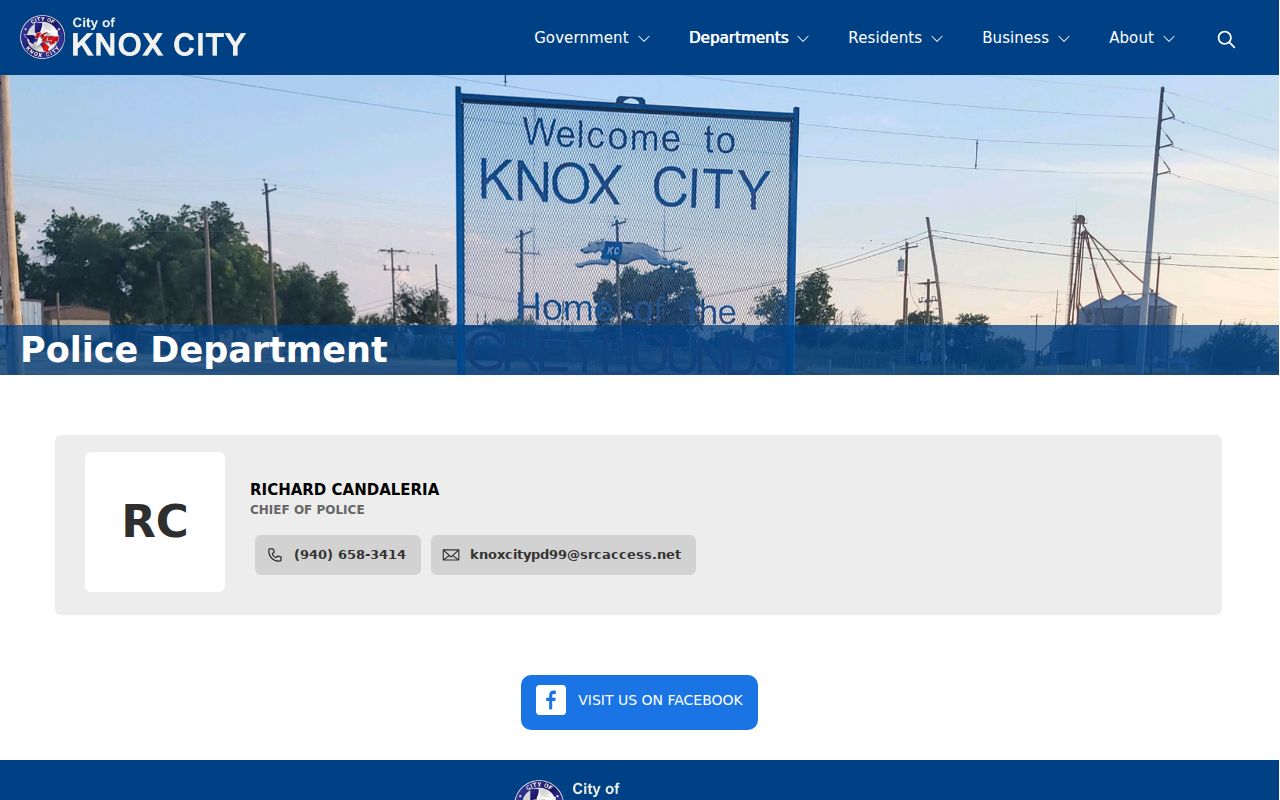
The Police page confirms the direct contact channel, but it does not promise online access or a set delivery time. Under the Texas Public Information Act, the city may release existing public material and redact protected parts. Active investigation details, juvenile information, victim data, medical facts, and sensitive identifiers may be withheld. The Act's ten-business-day Attorney General decision rule is not a promise that records will arrive within ten days.
Knox City Criminal Citation Trail
Knox City code gives a precise look at how one local record splits. For a noncustodial traffic citation, the original citation goes to Municipal Court. A duplicate goes to Police central records. That creates two related documents from the same encounter. The police copy preserves issuance information, while the court file becomes the place to learn what the judicial system ultimately did.
The Knox City citation-routing provision is the official source for that division of custody.
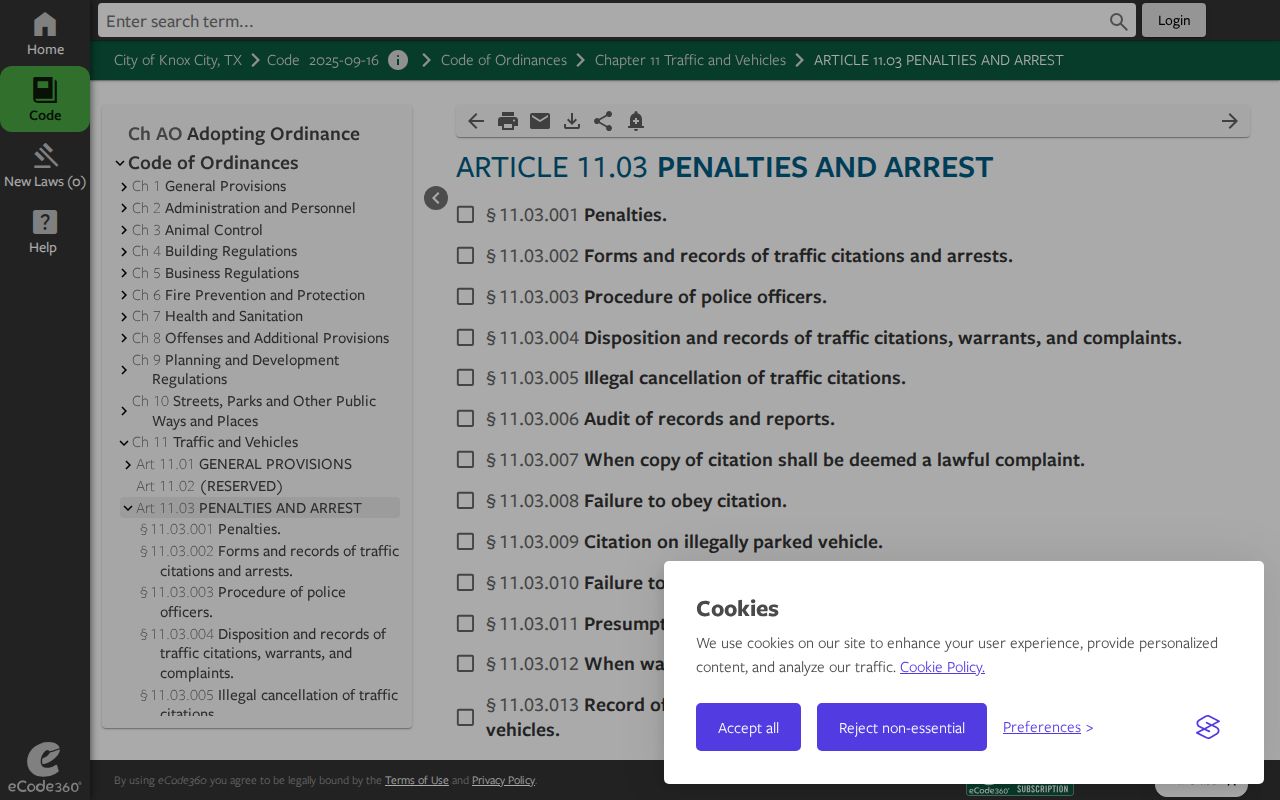
This routing rule explains why a Police response may be accurate yet still omit the plea, fine payment, bail forfeiture, dismissal, trial result, or another final court action. Ask both offices when the request concerns both the encounter and its outcome.
Note: A noncustodial citation can create police and court records without creating any jail booking record.
Knox City Arrests and Bookings
Knox City publishes no arrest blotter, booking feed, mugshot gallery, city jail roster, or city holding-facility page. It also does not publish an agreement stating where every person arrested by city officers is booked. That gap requires careful wording. Police can address its arrest report. If Knox City transferred a person to Knox County Jail, call the jail at (940) 459-2041 for current custody or booking questions.
An arrest allegation does not prove guilt. Booking reflects intake and custody, while a later prosecutor and court determine the filed charge and disposition. A city allegation may be changed, declined, reduced, or dismissed. The county jail also does not offer an online roster, so phone contact is the documented fallback. Broader channel details appear in the Knox County arrest lookup when a search moves beyond city records.
For a city arrest, record the arresting agency and event date first. Then follow the chain from Police to any accepting jail and, if charges were filed, to the correct court. Do not assume that the absence of an online Knox City entry means no record exists.
Knox City Police Copy Versus Judgment
A police citation copy and a court judgment answer separate questions. Police central records can document what the officer issued. Municipal Court records the judicial response. The result may include a trial, fine payment, bail forfeiture, dismissal, deferred disposition, or another lawful resolution. A requester who stops with the police copy may see the allegation but miss the outcome.
Use the date and citation number to connect the records. If the court cannot locate a city matter, confirm that the citation names Knox City Municipal Court rather than a justice, county, or district court. Class A and Class B misdemeanors and felonies do not become municipal cases merely because the event happened inside Knox City. Those filed cases move to county-level courts, where the combined clerk keeps the case file.
- Citation
- A written allegation and direction to respond, not a judgment of guilt.
- Disposition
- The outcome entered by the court, such as dismissal, conviction, or deferred disposition.
- Docket
- The dated record of actions taken in a court case.
- Deferred disposition
- A court process that postpones final judgment while stated conditions are completed.
Municipal Court Records in Knox City
Knox City Municipal Court handles city ordinance, traffic, and other fine-only matters within its jurisdiction. Its official court page publishes Thursday hours from 5:30 to 8:00 p.m. at 902 E. Main, with the shared phone and email. No payment portal, searchable docket, copy fee, or remote delivery policy was located. Call ahead, especially before planning a Thursday visit.
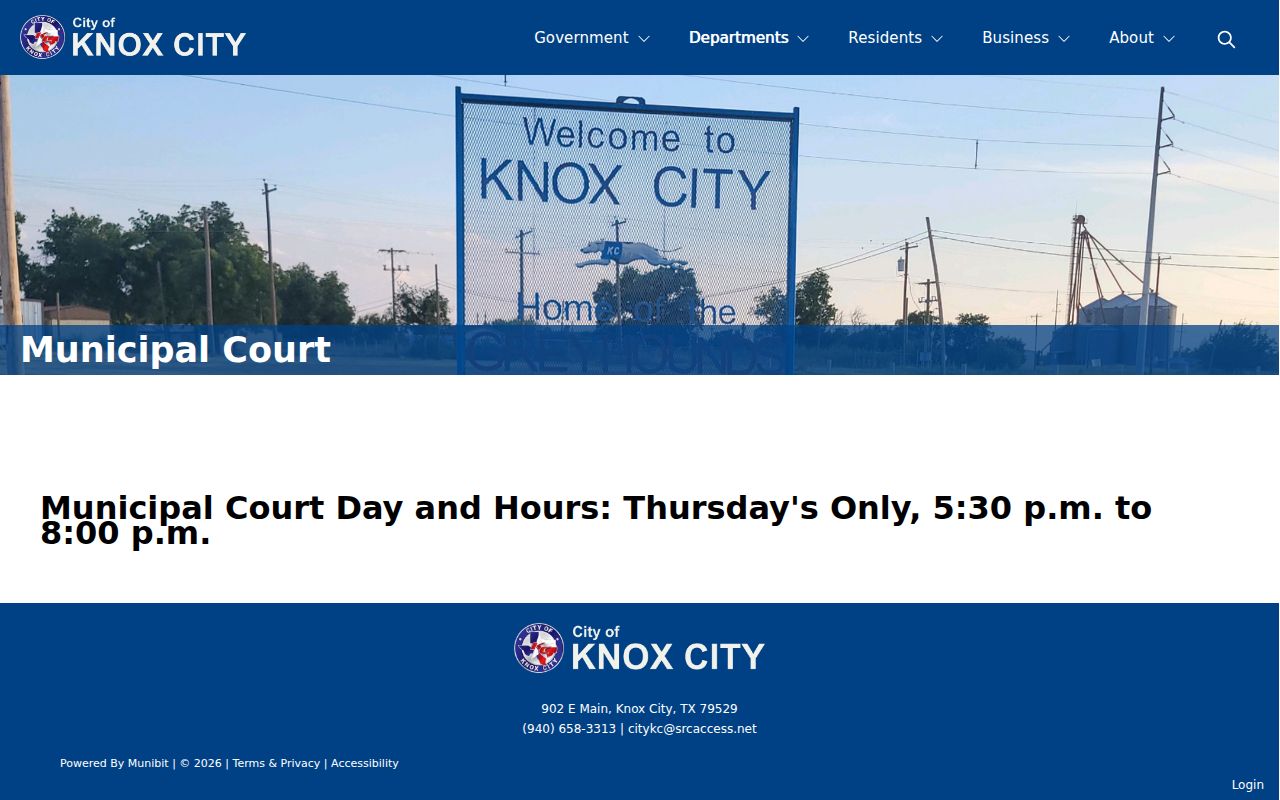
The court source makes the narrow evening schedule clear. It does not show that Police counter availability follows the same hours, so do not treat the two offices as interchangeable even though their contact details match.
| Court Name | Knox City Municipal Court |
|---|---|
| Case Types Heard | City ordinance, traffic, and other fine-only matters within municipal jurisdiction |
| Case Lookup Channel | Call, email, or contact the court at 902 E. Main; no online docket was found |
| What the File Shows | Citation or cause details, court actions, and the judicial disposition when available |
| Copies & Fees | No local copy fee or online payment channel was published; confirm with court staff |
Knox City Criminal Citation Fields
The city code also identifies the basic data placed on a noncustodial traffic citation. These fields can help a person describe the correct record without exposing information about a real individual. They also show why a name alone may not be enough when common names or old records are involved.
| Field | How It Helps |
|---|---|
| Name and address | Identifies the cited person and the address recorded at issuance |
| Operator's license number | Separates the person from similar name matches |
| Vehicle registration | Links the cited vehicle to the encounter |
| Alleged violation | States the claimed city or traffic offense |
| Response date | Shows when a response is due, set at least five days after issuance |
| Other pertinent information | Provides facts needed for the citation and court handling |
When requesting a Knox City citation record, supply the citation number if possible. If it is lost, provide the name, approximate date, location, and vehicle details that can narrow the search. Contact the court promptly about a missed response date. No official Knox City page states a standard outcome, clearance time, or payment method for that situation.
Where Knox City Records Go
A Knox City event can produce several records as it moves through the justice system. Police keeps the agency report or citation copy. Municipal Court keeps city fine-only matters. A custodial arrest may create a county jail booking if the jail accepts the person. Prosecutors and county courts handle higher-level filed charges. Those local events can later be reported into the Texas Department of Public Safety Crime Records Division systems.
Record flow: Knox City Police › Knox City Municipal Court or Knox County Courts › Texas Department of Public Safety
Timing matters. Police may hold the newest event record before a court case exists. The court file later shows the charge actually filed and its result. DPS provides reported Texas conviction and deferred-adjudication information through its public product, not a full copy of every Knox City police event. For court pleadings, judgments, and sentences above the city level, use the Knox County criminal court cases channel.
Knox City Thursday Court Records
Thursday evening access is a defining Knox City detail. The stated window is 5:30 to 8:00 p.m., but the published page does not promise that every requested file will be ready during a visit. Call first with the citation or cause number, name, and approximate date. Ask whether the file is active, whether inspection or a copy is available, and whether staff need time to retrieve an older matter.
The Knox City municipal-court code establishes the local court and explains that City Council appoints the municipal judge for a two-year term.
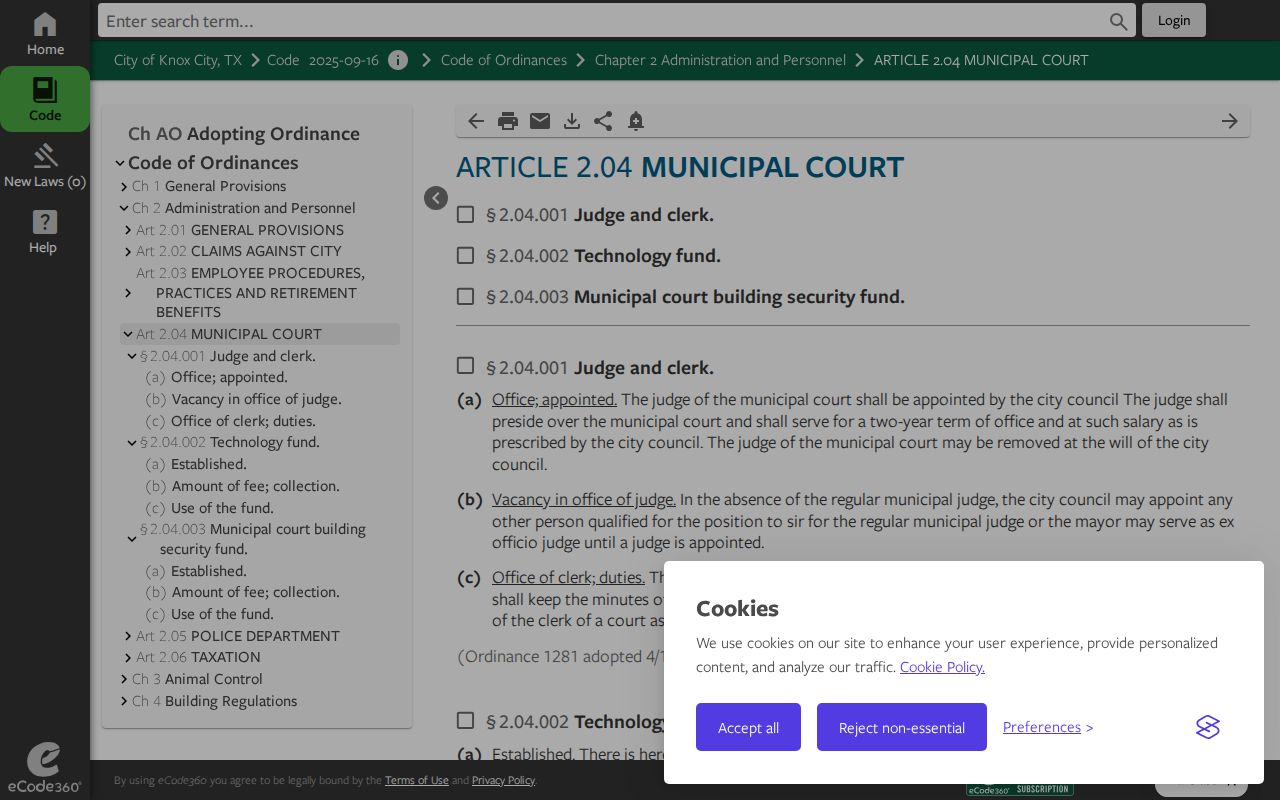
This structure is useful context, but the reviewed official page did not identify a current judge. Requests should go to the published court contact rather than to an assumed officeholder.
Knox City Fine-Only Record Limits
Not every old municipal case remains open to ordinary public review. Texas Code of Criminal Procedure article 45A.461 can make many fine-only records confidential five years after a final conviction or a deferred-disposition dismissal, subject to statutory exceptions. This rule can explain why a Knox City court record that once existed is no longer released in the same way.
Confidential does not mean the event never occurred, and it is not the same as expunction. Expunction is a court-ordered statutory process for qualifying records. An order of nondisclosure limits ordinary public dissemination while authorized entities can retain access. When a Knox City record seems missing, ask the custodian whether the file is confidential, restricted, archived, or held by a different court. Do not infer a result from an empty online search because Knox City has no online municipal docket.
Note: Fine-only confidentiality is rule-based and record-specific; age alone does not prove that a particular Knox City file must be withheld.
Public Access Rules in Knox City
Police records and court records use different access frameworks. A narrow request to Knox City Police can invoke the Texas Public Information Act for an existing city record. Judicial and case records are obtained through the court and applicable court rules. Either office may remove protected identifiers, victim or juvenile details, medical information, or facts covered by an active-investigation exception. A public record may also have a restricted counterpart that cannot be released.
Key Statutes:
Texas Public Information Act gives access to government records while preserving stated exceptions.
Texas Government Code Chapter 411 limits criminal-history dissemination and authorizes the narrower public DPS product.
Texas Code of Criminal Procedure Chapter 45A governs justice and municipal procedure, including fine-only confidentiality rules.
State the record sought, date range, known number, and desired format. If the city says another office holds it, note the agency and court named on the citation or paperwork. That detail can distinguish a Knox City police file from a municipal judgment, county booking, or district-court case.