
Sex Offender Checks in Knox County
The Texas Public Sex Offender Registry is the primary official search. It supports name and location queries that can be narrowed to Knox County. The sheriff does not publish a separate local map or list, so a local question that cannot be resolved from a profile goes to the Knox County Sheriff at 111 E. Hayes Street in Benjamin, (940) 459-2211.
DPS manages the public system; local law enforcement registers and verifies information. The profile should be checked for the reporting authority and current administrative status. A search result is not a substitute for the conviction judgment, and an absence from a particular map view is not proof that no registration exists.
Searches can answer different questions. A name query tests a known identity, while county, city, ZIP, address, and map methods explore a location. Run the mode that matches the question, then compare identifying details inside the profile. Similar names and nearby map markers should never be treated as confirmation by themselves.
Knox County Registry Contact
Knox County publishes the Sheriff’s main address and telephone but no special registry appointment hours, fees, form, or separate registration desk. Call first before a visit. Registrants must follow the instructions supplied by the responsible authority; members of the public should direct questions about a Knox location or suspected noncompliance to the Sheriff or DPS.
Knox County Sheriff
111 E. Hayes St.
Benjamin, TX 79505
(940) 459-2211
Hours and appointments: call first
DPS Registration Program
Texas statewide program
(512) 424-2800
Registry program questions
The local office performs registration functions, while DPS controls the public registry platform and statewide program guidance.
Published registration data can change after a move, verification, incarceration, release, or correction. The Sheriff can address local registration questions, but only the responsible agency should confirm whether a particular administrative requirement has been met. Public users should not attempt their own compliance investigation.
How to Search the Texas Public Sex Offender Registry
Choose the search mode that matches what is known. A name search works when spelling or aliases are available; a county, city, ZIP, address, or map search is better for a geographic question. Use the profile, not only the results list.
- Open the official DPS registry and review its accuracy, timeliness, and lawful-use notices.
- Enter a first and last name or select a geographic method such as address, city, ZIP, or county.
- Choose Knox as the county when narrowing a county-wide search and use the map or list controls to review results.
- Open the relevant profile, confirm identifiers and the reporting agency, and contact that authority if an entry appears inconsistent.
| Field label | Type | Required | Notes |
|---|---|---|---|
| Last Name / First Name | Text | Depends on search mode | Name and partial-name behavior is controlled by the portal. |
| Address | Text | No | Supports a geographic search when a location is known. |
| City | Text or selection | No | Narrows results to a municipality. |
| ZIP Code | Five-digit text | No | Useful when city boundaries are uncertain. |
| County | Selection | No | Select Knox for a county filter. |
| Institution of Higher Education | Selection | No | Campus-related search where the interface offers it. |
| Map / list controls | Interface | No | Changes how geographic results are viewed. |
Knox County Registry Search Interface
The DPS search screen is a gateway, not a statement about any individual. Search and Reset or Clear-style controls allow the query to be refined. Start narrowly enough to avoid confusing similar names, then widen the geographic criteria only if needed.
The official Texas registry search shows the public interface used for Knox County.
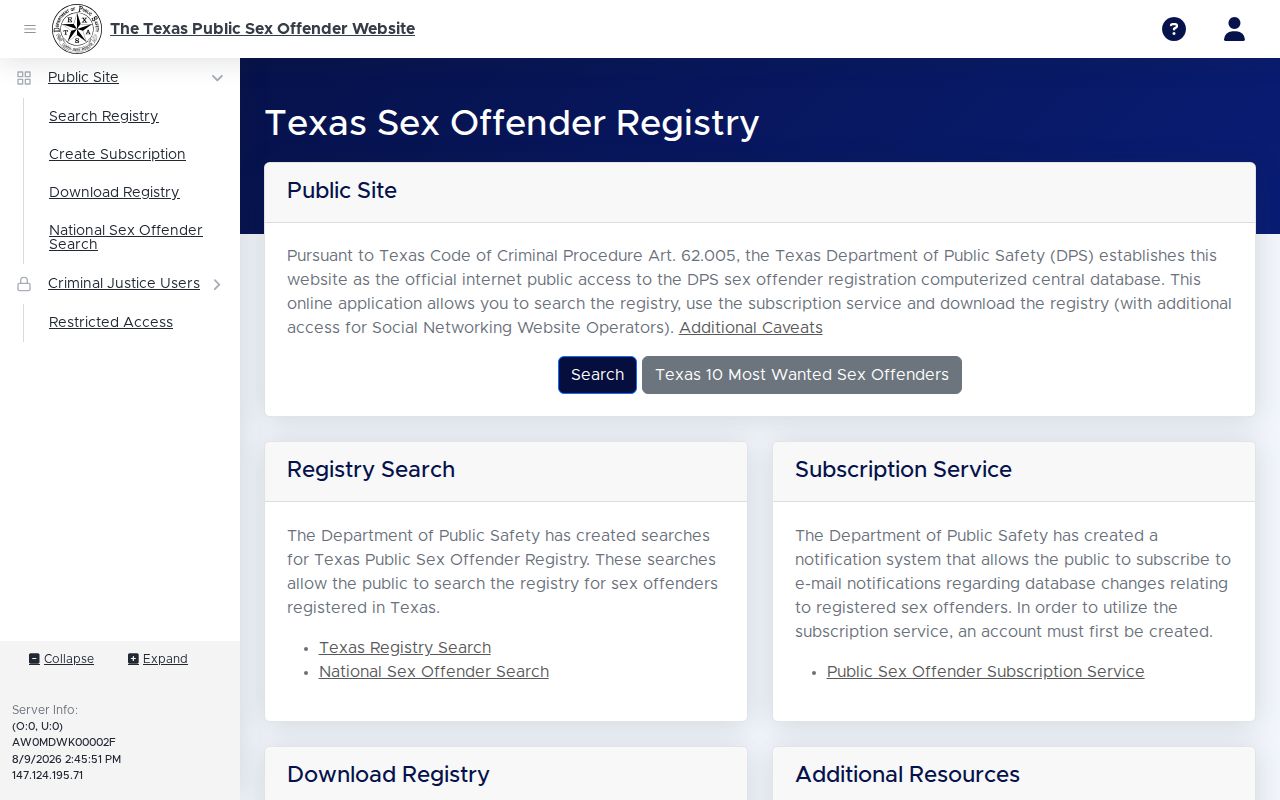
The search image is included without opening or republishing a private individual’s profile. That protects personal context while still showing the official access route.
Inside a Registry Profile
A public Texas profile combines identifiers, registration data, location, and the reportable offense. Not every profile carries every possible field, and display language may reflect the law or jurisdiction in effect at conviction.
| Name and aliases | Published legal name and other reported names used to distinguish records. |
|---|---|
| Photograph and description | Photo, sex, race, date of birth or age, height, weight, hair, eyes, and authorized marks or tattoos. |
| Address or location | Published residence, transient, incarceration, civil commitment, or other stated status. |
| Registration details | Status, verification information, reporting agency, and relevant dates. |
| Offense information | Description, statute, conviction date, institution or jurisdiction, and authorized victim category data. |
| Additional fields | Vehicle, work, school, or online identifiers where Texas law authorizes publication. |
Risk-level language addresses assessed notification risk; it does not rewrite the conviction, independently set the registration period, or supply a complete court history.
Offense labels can come from another jurisdiction or from statutory language in effect at the time of conviction. Read the jurisdiction, statute, conviction date, and registration status together. If the exact judicial outcome matters, obtain the court judgment from the court that decided the case rather than paraphrasing the registry label.
Knox County Registry Address Meaning
An address does not always describe a conventional permanent home. A profile can use terminology for residence, transient location, incarceration, civil commitment, or another statutory situation. Check the status and reporting authority before interpreting a map point.
A location can also change between verifications or reporting events. DPS warns about accuracy and timeliness, which is why the displayed registration information should be confirmed through the profile and responsible agency. For a concern about a specific Knox County location, contact the Sheriff rather than confronting anyone at the address.
Note: A marker near a boundary should be checked by address, ZIP, county, and the full profile because map placement alone can mislead.
Texas Registration Levels and Requirements
Texas does not present its public registry as a simple federal Tier I, II, and III chart. Duties and duration arise under Code of Criminal Procedure Chapter 62 and depend on the reportable conviction or adjudication, offense, repeat status, age, sentence or supervision dates, and any court modification.
| Texas category | General duration concept | Public interpretation |
|---|---|---|
| Statutorily listed lifetime categories | Lifetime registration | Confirm the profile and controlling Chapter 62 provision. |
| Repeat reportable convictions | Generally lifetime | Repeat status can affect the statutory duty. |
| Other reportable convictions or adjudications | Generally ten years after release, discharge, or end of supervision | The calculation is statute-specific and not simply ten years from conviction. |
| Juvenile or court-modified duties | Court- and statute-specific | Exemption, modification, or separate rules may apply. |
Verification frequency and community notification also depend on statutory facts. Do not infer a duty from offense wording alone; the registration authority and Chapter 62 control.
Any duration summary is a starting framework, not an individualized calculation. Release, discharge, supervision, repeat history, juvenile adjudication, and a later court order can change how the statute applies.
Knox County NSOPW Registry Searches
The U.S. Department of Justice’s National Sex Offender Public Website searches participating jurisdictions and is useful when movement across state lines is possible or the known location is near a boundary. It supplements rather than replaces the Texas profile and local reporting authority.
The NSOPW interface provides the official cross-jurisdiction route.
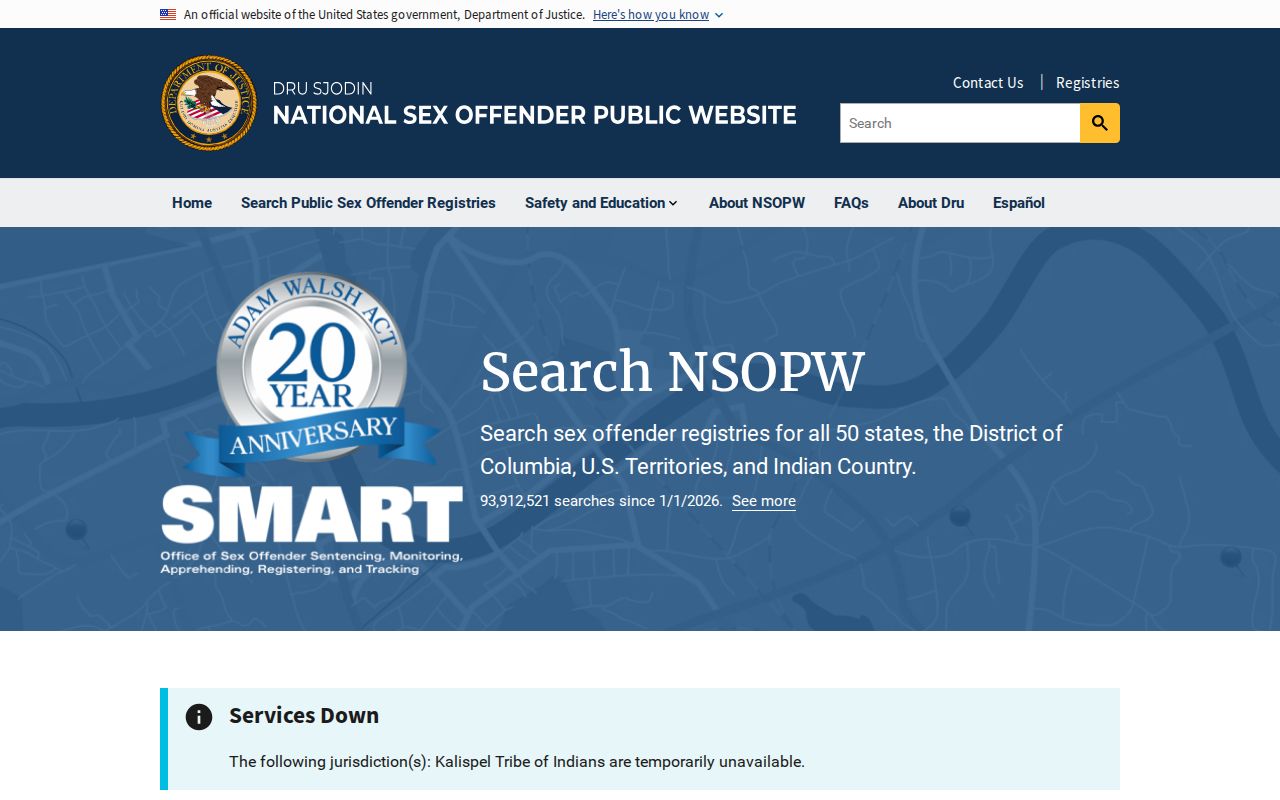
Repeat a geographic or name search there when a Texas-only query cannot answer whether another jurisdiction publishes a current entry.
Differences between portals can reflect timing, source systems, statutory publication rules, or record matching. Confirm discrepancies with the agency named on the profile.
For travel or relocation questions, repeat a search in every relevant jurisdiction. NSOPW is a useful federation of participating public registries, but it does not erase differences in state publication law or guarantee that every local update appears simultaneously. Preserve the profile’s source-agency information when asking for verification.
Knox County Registry Compliance Reports
Local law enforcement and DPS handle registration compliance; the public should not attempt enforcement. Record the observed concern without trespassing, surveillance, confrontation, or online publication, then provide the information to the Knox County Sheriff or DPS registration program.
A suspected address discrepancy may have an administrative explanation, including a different published status or an update in progress. Reporting through official channels allows the agency to compare the observation with nonpublic registration requirements. Emergency conduct should be reported through emergency services; routine registry questions belong on the published office lines.
Official verification: Use the authority named on the registry profile whenever possible. It is positioned to check current registration information and determine whether a compliance inquiry is warranted.
Community Notification and Lawful Use
The registry supports personal and family safety planning and community awareness. It does not authorize threats, harassment, vigilantism, trespass, discrimination, or a crime against a registrant or household. Texas Code of Criminal Procedure Chapter 62 governs registration, verification, notification, and offenses, while the portal itself carries use warnings.
Use registry information lawfully: Never threaten, harass, intimidate, or commit a crime against a person or household based on registry information. Send suspected noncompliance to law enforcement or DPS.
Community awareness is most responsible when facts are verified from the current profile, children and other household members are not targeted, and safety decisions remain proportionate to the published information. A registry entry is an administrative publication and does not replace the underlying court judgment.
For broader county record routing beyond registry data, the Knox County criminal history overview identifies court, arrest, jail, and DPS channels without merging them into the registry.